
Solar Panels in Tonypandy: Installation Costs, Savings and Payback
October 16, 2026
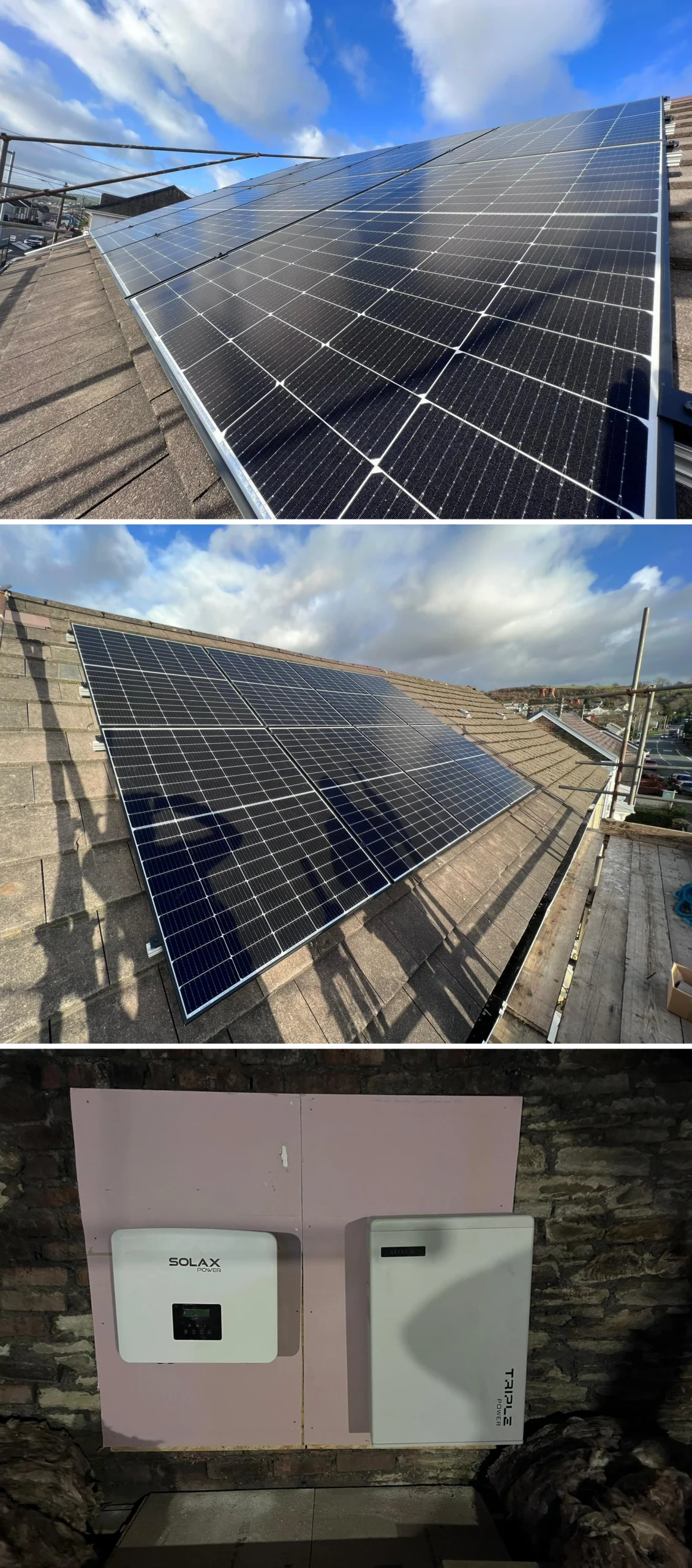
Solar panels in Tonypandy can help homeowners lower electricity bills, generate renewable energy and reduce the amount of power purchased from the National Grid.
Solar photovoltaic panels convert daylight into usable electricity. They continue producing energy during cloudy weather, although output varies depending on the season, available daylight and local conditions.
The performance of a solar panel installation in Tonypandy will depend on:
- Roof direction and pitch
- Available roof space
- Shading from hills and buildings
- Trees, chimneys and dormers
- Panel output and efficiency
- Inverter capacity
- Household electricity consumption
- Overall quality of the system design
South-facing roofs generally provide the highest annual generation. However, east- and west-facing roofs can also support effective solar PV installations.
A professional solar survey will determine whether the roof is suitable and provide a property-specific estimate of expected annual generation.
Solar panels and valley shading in Tonypandy
Tonypandy’s position within the Rhondda Valley makes a detailed shading assessment especially important.
Surrounding hills may reduce the amount of low-angle sunlight reaching some properties during the morning, late afternoon or winter months. Additional shading can be caused by:
- Trees
- Chimneys
- Dormer windows
- Neighbouring houses
- Commercial buildings
- Roof-mounted equipment
This does not automatically mean that a property is unsuitable for solar panels. The effect will depend on the position of the building, roof orientation and time of day when shading occurs.
A competent solar installer in Tonypandy should assess the likely effect of shading before recommending the panel layout, inverter and system capacity.
How much do solar panels cost in Tonypandy?
The cost of solar panels in Tonypandy depends on the proposed system size, equipment specification and complexity of the installation.
The Energy Saving Trust currently uses an indicative cost of approximately £7,600 for an average 4.5kWp domestic solar panel system.
This is a national estimate rather than a fixed price for every Tonypandy property.
Solar panel installation costs may be affected by:
- Number and output of the panels
- Panel and inverter specifications
- Roof height, pitch and condition
- Scaffolding and access requirements
- Shading and panel optimisers
- Electrical or consumer-unit upgrades
- Inverter location and cable routes
- Solar battery capacity
- Monitoring equipment
- G98 or G99 network requirements
- Bird-protection systems
A complete solar panel quotation should include the design, scaffolding, equipment, installation, electrical testing, commissioning, monitoring setup, MCS certification, warranties and customer handover documents.
A low headline price may not provide the best overall value if important installation, certification or aftercare services have been excluded.
How much could solar panels save?
Solar panels can reduce electricity bills by allowing homeowners to use renewable electricity generated at their property instead of buying all their power from an energy supplier.
The strongest savings are normally achieved when solar electricity is used while the panels are generating.
Households can improve solar self-consumption by operating suitable equipment during daylight hours, including:
- Washing machines
- Dishwashers
- Tumble dryers
- Immersion heaters
- Heat pumps
- Home-office equipment
- Electric vehicle chargers
Eligible solar panel owners may also receive payments for surplus electricity exported to the grid through the Smart Export Guarantee.
Actual savings will depend on:
- Annual solar electricity generation
- Household energy consumption
- Daytime electricity usage
- Import electricity prices
- Export tariff rates
- Solar battery performance
- Future changes in energy demand
A professional solar panel quotation should use recent electricity bills and a property-specific generation estimate when calculating potential savings.
What is the likely solar panel payback period?
The solar panel payback period is the estimated time required for electricity savings and export payments to recover the original installation cost.
Current Energy Saving Trust calculations, based on July 2026 energy prices, indicate an estimated payback period of approximately nine to ten years for its Welsh example location of Aberystwyth.
The result for an individual Tonypandy property may be shorter or longer depending on:
- Total installation cost
- Solar PV system size
- Roof direction and shading
- Predicted annual generation
- Household electricity consumption
- Daytime solar usage
- Import and export tariffs
- Battery cost and performance
- Maintenance requirements
- Future electricity prices
Payback should therefore be calculated using the proposed solar panel design and the customer’s actual electricity usage rather than relying on a generic national figure.
Is solar battery storage worthwhile?
Solar battery storage allows surplus electricity generated during the day to be stored for use later.
This can be useful for Tonypandy households where electricity demand is highest during the evening, after solar generation has reduced.
A solar battery may help homeowners:
- Use more of their solar-generated electricity
- Reduce evening grid consumption
- Store surplus daytime generation
- Use compatible off-peak electricity tariffs
- Monitor household energy consumption
- Reduce reliance on imported electricity
Battery capacity should be matched to the property’s solar generation and electricity demand.
An oversized battery may rarely reach full charge, while an undersized battery may not store enough electricity to support evening consumption.
Because battery storage increases the initial installation cost, customers should receive separate financial illustrations for a solar-only system and a combined solar-and-battery installation.
Standard solar batteries do not automatically operate during a power cut. Backup electricity requires compatible equipment, additional electrical work and a purpose-designed backup arrangement.
Planning permission for solar panels in Tonypandy
Many conventional domestic rooftop solar panel installations qualify as permitted development and do not normally require a full planning application.
Additional permission or consent may be needed for:
- Listed buildings
- Flats and maisonettes
- Properties in conservation areas
- Prominent installations
- Ground-mounted solar panels
- Installations affecting protected features
- Properties with restricted permitted development rights
Leaseholders may also require consent from their landlord, freeholder or management company.
Homeowners should review the current Welsh Government planning guidance for solar panels where there is any uncertainty.
G98 and G99 network requirements
Solar panels and battery systems operate alongside the local electricity network. The appropriate Distribution Network Operator process must therefore be completed.
A qualifying system operating at no more than 16 amps or 3.68kW per phase may fall under the G98 process. Systems exceeding this threshold or not meeting the relevant requirements will normally require a G99 application.
The correct process depends mainly on the inverter output, phase arrangement, battery configuration and export capacity—not simply the combined wattage of the solar panels.
A competent installer should manage the application or notification and provide the customer with the relevant network records.
Customers should also receive:
- MCS certification
- Electrical test documentation
- System schematic
- Generation estimate
- Product information
- Warranty documents
- Monitoring guidance
- Operating and isolation instructions
- Aftercare contact details
Solar panel installation across Tonypandy
Big Green Solar designs and installs solar PV and battery-storage systems for homes throughout Tonypandy and surrounding areas, including:
- Penygraig
- Trealaw
- Llwynypia
- Ystrad
- Clydach Vale
- Williamstown
- Porth
- The wider Rhondda area
Big Green Solar is a South Wales-based trading style of LMG Home Improvements Ltd.
Each recommendation begins with an assessment of the property, roof condition, valley shading, electricity consumption and future energy requirements. This allows the panel capacity, inverter, battery options and expected performance to be properly evaluated.
Request a solar panel quotation in Tonypandy
If you are considering solar panels or battery storage in Tonypandy, the Big Green Solar team can assess your property, electricity usage and future energy requirements before preparing a tailored quotation.
Visit Big Green Solar, complete the online quotation form or call 0333 210 0083 to arrange a solar panel survey in Tonypandy.
For cavity wall extraction, external wall insulation, rendering, roofing and other property-improvement services, visit LMG Home Improvements or call 0333 210 0083.
Solar panel costs, savings and payback estimates are indicative. Actual results depend on the property, system design, valley shading, electricity consumption, tariffs, maintenance requirements and future energy prices.